Asset hypothesis
Stable assets are design commitments.
Under rapid prompt/code rewriting, the durable asset is an inspectable design commitment: pointcut, contract, permitted variation, test obligation, negative control.
A field guide to the recurring decisions around AI agents: what may vary, what must hold, and what happens when it does not.
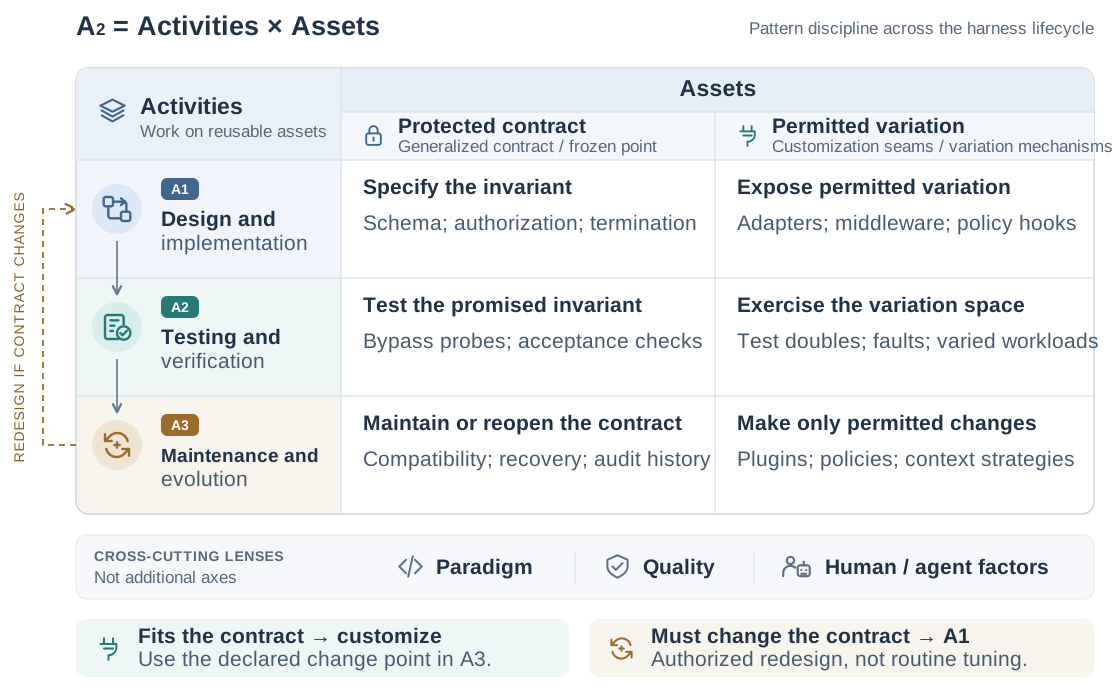
Activities ask when an obligation is designed, verified, and revisited. Assets ask what must hold and what may change. The dashed return is re-generalization: the contract itself is reopened.
Families record provenance, not another taxonomy axis. E records are research mechanisms, not claims of independently established recurring patterns.
Each record informs a hypothesis through its A² activity coordinate: A1 (design) specifies the durable commitment, A2 (verification) exercises mechanized separation, and A3 (evolution) tests bounded self-modification. This is a reading lens—not a change to any frozen pointcut, contract, cue, or evidence value.
Under rapid prompt/code rewriting, the durable asset is an inspectable design commitment: pointcut, contract, permitted variation, test obligation, negative control.
Agent-led evolution requires guards, gates, checkpoints, rollback, and evaluation that separate proposal from authorization—documentation alone is not a constraint.
Bounded self-modification should reduce contract drift and regression and improve recovery and attribution relative to unconstrained revision.
Search by responsibility, mechanism, or join point. Filter without losing the underlying record.
Try a broader term or clear one of the filters. An empty filtered view says nothing about implementations in repositories.